



While the phrase “research peptides for sale” might bring to mind the Kylo Peptides website and scientific laboratories, there’s actually a fascinating connection to your lawn that’s worth understanding. Agricultural researchers use peptides to study plant growth, stress resistance, and soil health, but here’s what matters for your yard: the real-world applications of that research have already made their way into the products and techniques you use every Saturday morning.
If you landed here looking for biochemical compounds, you’re probably in the wrong place. But if you’re tired of brown patches, stubborn weeds, and grass that won’t thrive no matter what you try, you’re exactly where you need to be.
I’ve spent years testing lawn care methods, talking with homeowners who’ve transformed their yards, and learning what actually works versus what’s just marketing hype. The truth is, you don’t need laboratory-grade solutions to solve most lawn problems. What you need is a clear understanding of your grass type, soil conditions, and the specific challenges your yard faces.
This guide cuts through the confusion and gives you practical, proven strategies for common lawn issues. We’ll cover everything from identifying nutrient deficiencies to timing your fertilizer applications correctly, plus how to choose products that deliver results without emptying your wallet. Whether you’re dealing with patchy growth, persistent weeds, or soil that seems to reject everything you plant, there’s a straightforward solution that doesn’t require a chemistry degree.
The Real Culprit Behind Patchy, Weak Grass
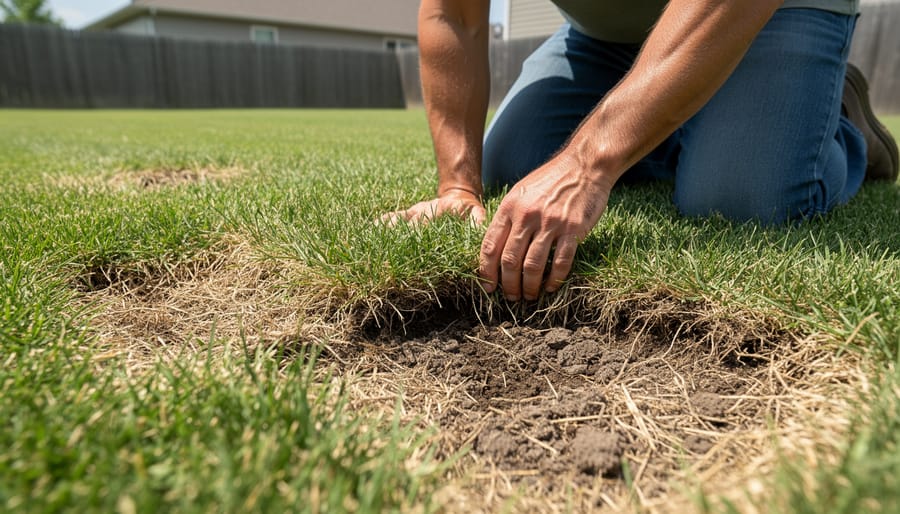
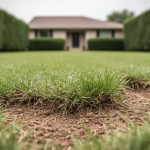
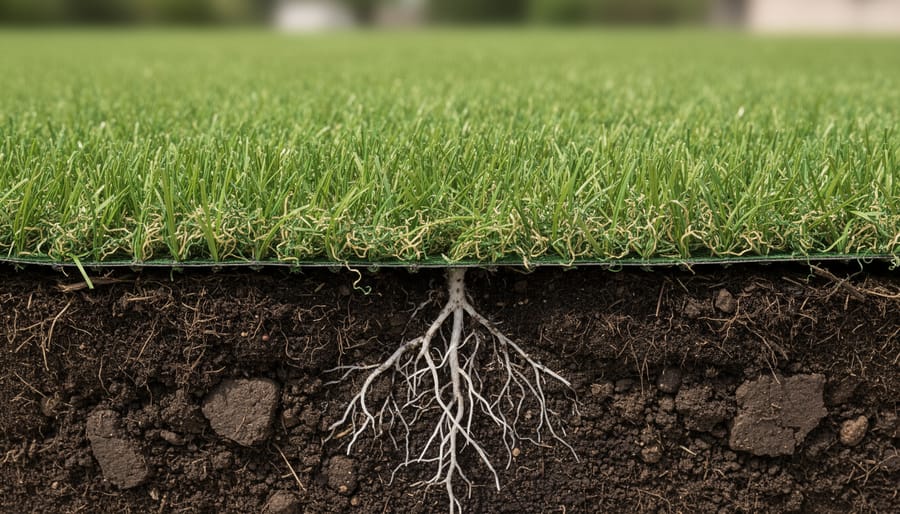
I spent years dumping fertilizer on dead patches in my backyard, convinced I had a grub problem or some mysterious disease. Turned out, my soil was so compacted that grass roots couldn’t push through more than an inch deep. When I finally dug up a square of the worst section, the roots looked like they’d hit concrete.
Most homeowners never look beneath the surface. You see brown spots or thin areas and immediately think: not enough water, wrong fertilizer, maybe chinch bugs. But the single most common reason for struggling grass is something you can’t spray away. Your soil is crushed tight, usually from foot traffic, mower wheels running the same pattern week after week, or just settling over time. When soil compaction reduces oxygen flow and water infiltration, grass roots suffocate and can’t access nutrients no matter how much you apply.
Here’s the telltale sign: step on your lawn after a rain. If your footprint fills with water and stays soggy, or if the ground feels rock-hard during dry weather, you’ve got compaction. I used to think my clay soil was just naturally tough. It wasn’t until a neighbor pointed out that healthy soil should give slightly when you walk on it, like a firm sponge, that I realized the problem.
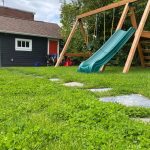
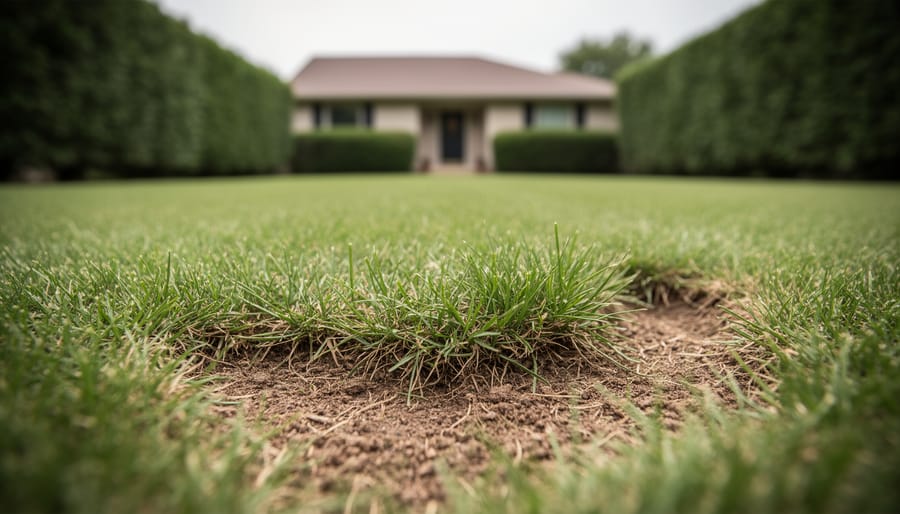
Drought stress and pest damage show specific patterns: grubs create irregular dead zones that peel back like carpet, while drought turns grass uniformly brown across sun-exposed areas. Compaction creates patchy weakness everywhere, especially along paths and under play areas. The grass doesn’t die outright. It just struggles, grows slowly, thins out, and lets weeds take over because their roots adapt better to hard soil.
The frustrating part? You can water perfectly and fertilize on schedule, but if those roots can’t spread, nothing else matters.
What Your Grass Is Really Trying to Tell You
Your lawn is basically a living billboard advertising exactly what’s wrong, you just need to know how to read it. Most homeowners see yellowing grass and immediately blame lack of water or fertilizer, when the real message could be something completely different.
Let me share what I’ve learned from years of misreading my own lawn’s signals. That pale yellow-green tint I kept dumping nitrogen on? Turned out my soil pH was so acidic the grass couldn’t absorb nutrients no matter how much I fed it. I wasted an entire season and a fair bit of money before I figured that out.
Here’s the truth: grass doesn’t lie, but it does speak in a language most of us never learned. Color changes are the most obvious signals, but they’re also the most misunderstood. Deep blue-green grass that looks almost gray? That’s actually drought stress beginning, not a sign of health. Bright, lush green that grows like crazy after you fertilize? You’ve probably just forced a growth spurt that weakened the root system.
Growth patterns tell an even clearer story if you know what to look for. When grass grows in uneven clumps with bare patches between, you’re not dealing with a seeding problem, you’re seeing the fingerprint of soil compaction. Roots literally can’t penetrate those hard spots, so grass gives up trying. I’ve watched neighbors spend hundreds on overseeding these areas year after year, never addressing the concrete-like soil underneath.
| What You See | What It Actually Means | Immediate Action |
|---|---|---|
| Yellow grass with dark green weeds | Soil pH imbalance blocking nutrient uptake | Test soil pH before adding anything |
| Grass blades with shredded, white tips | Dull mower blade tearing instead of cutting | Sharpen or replace mower blade |
| Circular brown patches that spread | Fungal disease from overwatering | Reduce watering frequency immediately |
| Thin grass with thick thatch layer | Grass suffocating from lack of soil contact | Dethatch and adjust mowing height |
Texture matters more than most people realize. Run your hand across your lawn. If it feels spongy, you’ve got excessive thatch buildup creating a barrier between grass roots and actual soil. If it feels crispy even when the soil is moist, you’re likely dealing with a grub problem below the surface, not a watering issue.
The biggest misconception I see homeowners make is treating every brown spot like it needs water. Sometimes brown means overwatered and fungus-infected. Sometimes it means your dog’s favorite bathroom spot. Sometimes it means you scalped that area with the mower last week. Learning to distinguish between these takes observation, not guesswork.
The Mowing Mistakes That Sabotage Your Lawn
You’re probably cutting your grass too short. I did this for years, thinking a golf-course look meant healthy turf, until I noticed my lawn getting thinner each season. University extension research confirms that mowing too short harms lawns by weakening root systems and inviting weeds. Most cool-season grasses need three to four inches of height. Warm-season varieties do better at two to three inches. When you scalp grass below these thresholds, you stress the plant and force it to divert energy from root growth to blade regeneration.
The one-third rule matters more than most people realize. Taking off more than a third of the blade length in a single cut shocks the grass and leaves it vulnerable. One reader told me he switched from weekly scalping to mowing every four days during peak growth, keeping his mower deck high, and his bare spots filled in within a month. The grass had energy to spread instead of just surviving each brutal trim.
Pattern repetition creates another hidden problem. Mowing the same direction every time compacts soil along your wheel tracks and trains grass to lean one way, making it look uneven. I alternate my mowing pattern each week, switching between horizontal, vertical, and diagonal passes. The lawn stands straighter, and I can see where the mower missed spots more easily. Knowing how to edge properly also helps create clean borders that frame your mowing work.
Dull blades tear grass instead of cutting it cleanly. Those ragged brown tips you see a day after mowing signal blade damage, not some mysterious disease. I sharpen my mower blade three times per season now, and the difference is obvious. The grass recovers faster, looks greener, and resists disease better because it’s not nursing torn wounds.
Timing your mow makes a difference too. Cutting wet grass clumps up, spreads disease, and gives you an uneven result. Mid-morning after dew dries works best for most schedules. Evening mowing leaves grass vulnerable overnight while cut ends are still open.
Why Throwing More Product at Your Lawn Makes It Worse
I learned this lesson after spending nearly $400 one spring, convinced my struggling lawn just needed more help. I doubled down on fertilizer applications, watered every day, and applied every treatment the garden center recommended. Three months later, my grass looked worse than ever, thin, yellowing, and perpetually thirsty.
Here’s what nobody tells you: grass is remarkably self-sufficient when conditions are right. When you constantly dump products on it, you’re not solving problems. You’re creating new ones.
Overfertilizing triggers a growth surge that looks impressive for about two weeks. But that rapid growth creates shallow, weak roots because the grass doesn’t need to search for nutrients. It becomes dependent on your next application. The excess nitrogen also accumulates salts in the soil, burning roots and killing beneficial microbes that naturally feed your lawn. I watched this exact cycle play out in my own yard, lush green one week, brown patches the next, always needing another bag of something.
The watering trap works the same way. Daily watering trains roots to stay near the surface where moisture is easy to access. When you skip a day or hit a hot spell, those shallow roots can’t reach deeper water reserves. Your grass wilts faster than a neighbor’s lawn that gets watered less frequently but more deeply.
The fertilizer spreader became my crutch instead of a tool. I was applying product every six weeks because I thought I had to, not because my lawn actually needed it.
Breaking this cycle meant accepting that less really is more. I cut fertilizer to twice a year, watered deeply just twice a week, and let my grass toughen up. The first month looked rough. By month three, I had healthier grass than I’d ever managed with my expensive product routine. The roots grew deeper, the color stayed consistent, and I stopped being a slave to the spreader schedule.
Simple Fixes That Actually Work
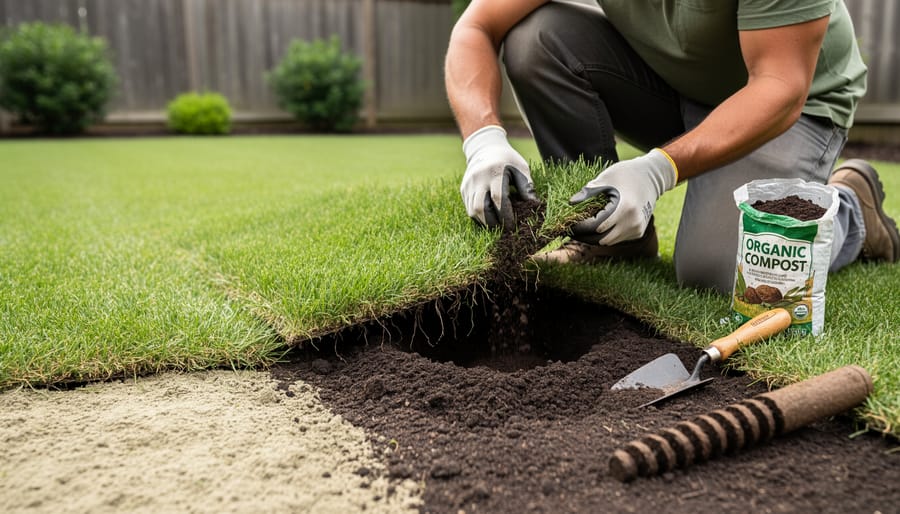
You don’t need to spend hundreds on lawn services when four straightforward fixes will solve most lawn problems. I learned this after wasting money on treatments that didn’t address the underlying issues my grass was actually facing.
Start with core aeration, the single most effective intervention for compacted soil. Rent a plug aerator (around $60 for a half-day) in early fall or spring when your grass is actively growing. Walk it across your lawn in two perpendicular passes, leaving those finger-sized soil plugs right on the surface, they’ll break down naturally within a few weeks. The immediate improvement in water penetration and root growth is genuinely impressive. If renting feels like overkill for a small yard, a manual aerator works fine for patches under 1,000 square feet, though it’s more of a workout.
Fix your mower setup next. Raise that blade to three inches minimum (3.5 to 4 inches for fescue). Sharpen the blade twice per season, spring and midsummer, because dull blades tear grass instead of cutting it, creating those brown, frayed tips that invite disease. Check blade sharpness by running your thumb along the edge; if it won’t catch on your skin, it’s too dull. Most hardware stores sharpen blades for under $10, or buy a file and do it yourself in fifteen minutes.
Invest in a soil pH tester and actually use it. Testing takes five minutes and costs less than $15 for a decent meter. Most grass prefers pH between 6.0 and 7.0. If you’re outside that range, you’ll waste every dollar spent on fertilizer because nutrients simply won’t be available to the roots, no matter how much you apply. Low pH? Add lime. High pH? Work in sulfur. Test again in six weeks and adjust.
Seasonal adjustments matter more than any single product. Water deeply but infrequently, one inch per week, including rain, to encourage deep root systems instead of shallow, dependent ones. In summer, that might mean two 30-minute sessions rather than daily spritzing. Skip fertilizer during heat stress (above 85°F for cool-season grasses), and save nitrogen applications for fall when your grass actually uses it for root development. For regions with brutal summers, follow extreme summer care protocols that prioritize survival over growth.
Here’s a practical recovery plan that turned my patchy disaster around in one season:
- Test soil pH in early spring and correct it before doing anything else
- Aerate in mid-spring when soil is moist but not waterlogged
- Adjust mower height immediately and sharpen the blade
- Apply appropriate fertilizer only after pH is corrected, following soil test recommendations
- Water deeply twice weekly rather than lightly every day
- Overseed any bare patches in early fall when temperatures cool
- Aerate again in fall and apply a final fertilizer round before dormancy
None of these fixes require specialized knowledge or expensive equipment you’ll use once. The transformation happens because you’re addressing root causes instead of masking symptoms with temporary treatments.
Transforming your lawn doesn’t require a complete overhaul or emptying your wallet on the latest miracle products. The reality is simpler: once you understand what’s actually going wrong, fixing it becomes straightforward.
Start with just one change. If compaction seems likely, rent an aerator this fall. If your mower’s been scalping the grass, adjust that blade height tomorrow. Pick the issue that resonates most with your situation and tackle that first. You’ll see improvement within weeks, which builds momentum for the next step.
The homeowners who’ve shared their successes with me didn’t transform their lawns overnight. They made informed adjustments based on understanding their grass’s actual needs rather than assumptions. That knowledge proved far more valuable than any expensive treatment program.
Yes, lawn recovery takes patience. Your grass didn’t decline in a week, and it won’t bounce back that quickly either. But consistency with the right practices always wins. Give your lawn a full growing season with these corrections in place, and you’ll wonder why you ever stressed about it in the first place.